When you're building a connected product, the hardware is only the beginning. The real differentiator (and time sink) is often everything around it: The customer-facing application, device visibility, fleet workflows, alerts, dashboards, and the confidence that your solution will actually scale before you ship.
That's exactly where the Digi IoT Application Framework comes in. Delivered as an extension to Digi ConnectCore Cloud Services, the framework provides a modular architecture and a reference application you can white-label, extend, or repurpose, so you can move from concept to production-grade IoT application with far less reinvention.
Read on to learn how this advanced application framework helps OEMs accelerate IoT application development with dashboards, remote device management, cloud integration, and scalable testing.
What Is the Digi IoT Application Framework?
 The Digi IoT Application Framework is a flexible, scalable reference implementation that helps OEMs accelerate the development, testing, and deployment of web applications for connected devices, especially those built on Digi ConnectCore system-on-modules (SOMs) and managed through Digi ConnectCore Cloud Services.
It's designed to give product teams a practical "launchpad" for building production-ready IoT apps, with capabilities like:
- Dashboards, alarms, and alerts
- Location + status tracking for active devices
- Templates to keep devices consistent and compliant
- A built-in Cloud Log to monitor cloud communications between the web app and backend (hugely helpful for debugging and audit/compliance workflows)
- Seamless integration with Digi APIs/services for secure connectivity, remote configuration, logging, and OTA software updates
And when you want to validate scale before field deployments, it pairs naturally with the Digi IoT Device Simulator, which can generate thousands of virtual devices with configurable behaviors, including "messy real life" scenarios like failed updates and disconnections.
The Biggest Benefits of the Digi IoT Application Framework (in Plain English)
What will the Digi IoT Application Framework do for you?
1. Faster time-to-market for customer apps
Instead of starting from scratch on a portal/app, you begin with an established framework and extend it to your product's needs, including UI, workflows, device views, and integrations included.
2. Lower risk when scaling from pilot to fleet
Using the simulator and digital-twin-style workflows, teams can validate performance and resilience at scale before real devices go out the door.
3. Built for real operations: updates, monitoring, and remote actions
Because it leverages ConnectCore Cloud Services, the framework supports the day-two "keep it running" work that matters most, including core fleet ops like real-time monitoring, remote device management, and OTA update workflows.
4. Easier troubleshooting and audit readiness
The Cloud Log provides visibility into cloud communications, helping teams quickly verify behavior, debug issues, and support audit/compliance needs.
Use Cases: Where the IoT Application Framework Shines
The Digi IoT Application Framework is intentionally cross-industry, but it's especially valuable anywhere you need visibility, mapping, alerts, remote updates, and fleet-scale operations.
Transportation and smart mobility
- Track vehicle/device location and status
- Optimize routes and improve uptime through live monitoring
- Prototype with a "smart transit" scenario using the framework + simulator
Manufacturing and industrial automation
- Monitor equipment performance and health signals
- Build workflows for predictive maintenance and service dispatch
- Validate fleet reliability with simulated edge behaviors (disconnects, update failures)
Energy and infrastructure operations
- Centralize visibility for distributed assets
- Apply alarms/alerts for anomalies and threshold events
- Ensure consistent configurations across large deployments with templates
Healthcare and clinical environments
- Monitor connected devices across facilities
- Improve reliability and response time with real-time dashboards and alerts
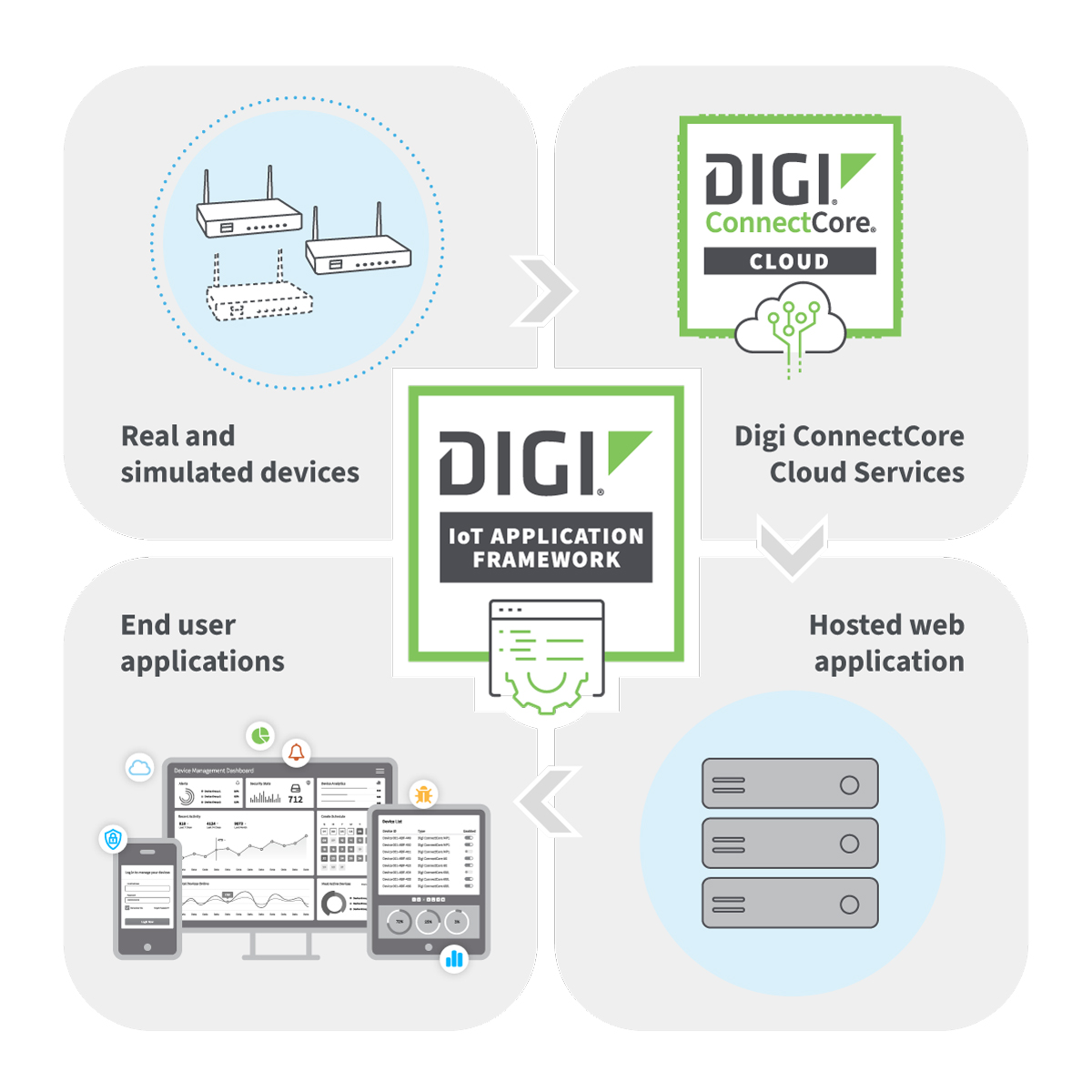
A Practical "Edge-to-cloud" Stack for OEMs
The Digi IoT Application Framework is part of a complete OEM solution, combining:
If your product roadmap includes a service portal, customer smart device app, digital-twin visualization, scalable device workflows, or simply "a better way to prove this will work at 10,000 devices," this framework is designed to help you get there with fewer unknowns.
Ready to See It in Action?
Digi has a short overview video recorded at SIDO Lyon 2025 that introduces the IoT Application Framework as a visualization tool for viewing real and simulated devices on a dashboard or a map, which is useful for planning, testing, deployment, and ongoing management.
And if you're ready to explore deeper, the product page also links to source code/documentation via the Digi Embedded Documentation Portal.
Digi IoT Application Framework FAQ
What is the Digi IoT Application Framework?
The Digi IoT Application Framework is a modular, extensible web application framework (a reference implementation) designed to help OEMs and solution builders accelerate the creation of customer-facing IoT applications like portals for monitoring devices, viewing status on dashboards, mapping assets, and managing alerts, built around Digi ConnectCore Cloud Services.
Who is the Digi IoT Application Framework built for?
The Digi IoT Application Framework is for teams building connected products who need to deliver a polished application experience without reinventing the basics. This includes:
- Product teams launching a connected device for the first time
- Engineering teams that want a strong starting point for a custom portal
- Operations teams that need scalable device visibility, alerts, and update workflows
Is the Digi IoT Application Framework a finished "off-the-shelf" app or a framework?
It's a framework/reference implementation meant to jump-start a production app. You can:
- Use it as-is for demos/POCs
- Extend it for your workflows and UI
- White-label it as your branded portal experience
What problems does the Digi IoT Application Framework solve?
Here are common pain points this framework helps address:
- Building an IoT portal from scratch (auth, UX flows, dashboards, device views)
- Getting to a usable demo quickly (for customers, stakeholders, or pilots)
- Creating consistent fleet workflows (templates, device grouping, standard configs)
- Reducing risk before scaling (test and validate behaviors at fleet scale)
What can I build with the Digi IoT Application Framework?
Typical outcomes include:
- A customer portal for device/fleet monitoring
- Dashboards for KPIs, device health, and usage trends
- Map-based "digital twin" style visualization for field assets
- Alarm/alert workflows for operations teams
- Update orchestration and rollout monitoring experiences
Does the Digi IoT Application Framework support real devices and simulated devices?
Yes. The framework can visualize and manage real devices, and it also pairs well with the Digi IoT Device Simulator so teams can validate workflows with thousands of virtual devices before field deployment.
Why use a device simulator at all?
Using a device simulator is important because physical devices are expensive, slow to provision, and hard to scale quickly in a lab. Simulation helps you:
- Load test dashboards and APIs
- Validate alerting and workflows under realistic conditions
- Practice "failure modes" like disconnects and update failures safely
What is the "Cloud Log" and why does it matter?
The Digi IoT Application Framework Cloud Log provides visibility into cloud communications between the web app and backend services, which can significantly speed up:
- Troubleshooting and debugging
- Validating expected system behavior
- Operational audits and support handoffs
Does the Digi IoT Application Framework include alerts and alarms?
Yes, alerting is one of the core application patterns it's built to support, so ops teams can detect anomalies and respond quickly.
Can we customize the Digi IoT Application Framework UI and workflows?
Absolutely. The framework is designed to be extended from branding and navigation to device screens, workflows, roles, and integrations with your existing systems.
Can the Digi IoT Application Framework integrate with our existing systems (CRM/ERP/data lake/BI tools)?
In most cases, yes. Many teams use it as the "front door" for device operations while integrating data and workflows into their existing stack via APIs and event flows.
How does the Digi IoT Application Framework relate to Digi ConnectCore Cloud Services?
ConnectCore Cloud Services provides the core cloud services layer for device lifecycle management. The IoT Application Framework sits above it as the application layer, accelerating development of the web app experience that customers and operators use.
Do I have to use Digi ConnectCore SOMs to use the IoT Application Framework?
The framework is closely aligned with Digi's ConnectCore ecosystem, but the practical requirement is typically the cloud/services integration. If your devices can be managed through ConnectCore Cloud Services, the framework becomes a strong accelerator.
Is the Digi IoT Application Framework intended for proof-of-concepts or production deployments?
Both. Many teams start with a POC or pilot, then evolve it into a production-grade application by extending modules, hardening workflows, and scaling infrastructure practices.
What does "modular" mean in practice for teams working with Digi SOMs and the IoT Application Framework?
It means you can implement only what you need:
- Start with dashboards + map view
- Add alerting workflows later
- Add device templates, update orchestration, role-based views, etc. over time
How does the Digi IoT Application Framework help reduce time-to-market?
Instead of building foundational portal capabilities from scratch, you begin with established application patterns and extend them, so your team focuses on differentiation (your device value and your workflows), not plumbing.
What's the first step to evaluate the Digi IoT Application Framework?
Where can I get documentation and resources for the Digi IoT Application Framework?
Digi provides product information and links to documentation/resources through the Digi Embedded Documentation Portal (referenced from the framework's product page).