Summary
5G has moved from "future technology" to the default network layer, now carrying the majority of mobile data traffic and outperforming LTE on speed, latency, and device capacity — especially in Standalone (SA) mode, which unlocks network slicing and the lowest latency. LTE isn't disappearing overnight, but carriers are steadily reallocating ("refarming") its spectrum to 5G, which means LTE performance and device activations can degrade well before any official shutdown date. 5G RedCap now fills the mid-tier IoT gap that LTE used to own, delivering LTE-comparable speeds at lower cost and power while running on the future-proof 5G SA core. For new deployments, the safest bet is hardware that supports 5G SA, the right spectrum bands, eSIM, and strong uplink performance — a platform approach that can adapt as carrier networks keep shifting.
In this blog post we look at 4G LTE vs 5G to help you pick the right technology for your requirements. When we first published this post in 2022, the question most organizations asked was "should I wait for 5G?" In 2026 the question has inverted. 5G is the default network layer in most developed markets, and the harder question is how much longer a new LTE deployment will remain a good investment.
Two things changed the math. First, 5G reached scale: global 5G subscriptions passed 3 billion in the first quarter of 2026 and are forecast to more than double to 6.4 billion by the end of 2031. Second, and more important for anyone planning a fleet, carriers have started moving spectrum out of LTE and into 5G. LTE is not being switched off, but the spectrum behind it is being reallocated. And spectrum is the lifeblood of cellular networks.
This post covers what actually differs between the two technologies today, what 5G RedCap changed for mid-tier IoT, how spectrum refarming affects deployed devices, and how to future-proof what you build now.
Key Takeaways: 4G LTE vs. 5G
- LTE remains viable today, but plan for a soft shutdown over the next five years, not a hard one. LTE still offers near-universal coverage and the lowest-cost module ecosystem, making it a legitimate choice for cost-sensitive and short-lived deployments. But as carriers refarm LTE spectrum into 5G, LTE capacity contracts gradually — showing up as throughput drops, activation refusals, and coverage gaps at cell edge — well before any official retirement date.
- 5G delivers three core advantages over LTE: speed, latency, and capacity. Real-world 5G speeds now median around 275–315 Mbps in leading markets, with some locations exceeding 1 Gbps, and theoretical peaks up to 20 Gbps, versus LTE's tens of Mbps. Latency can drop to single-digit milliseconds in 5G Standalone deployments, and 5G supports far more connected devices per coverage area than LTE.
- The NSA vs. SA distinction matters more than the "4G vs. 5G" label. Non-Standalone 5G still depends on an LTE core and delivers throughput gains without the full benefits of 5G. Standalone 5G is what unlocks network slicing, the lowest latency, and 5G RedCap — and it's the architecture carriers are actively building toward.
- 5G has already become the dominant traffic layer, not just the newest one. 5G carried 48% of global mobile data traffic by the end of 2025, projected to reach 85% by 2031. Global 5G subscriptions passed 3 billion in Q1 2026 and are forecast to reach 6.4 billion by 2031, with North America ending 2025 at 79% 5G subscription penetration.
- 5G RedCap closes the mid-tier IoT gap that made LTE the default for a decade. Delivering LTE-comparable speeds (50–200 Mbps) at roughly 65% lower modem cost and reduced power draw, RedCap runs on the 5G SA core — giving mid-tier deployments like smart meters, kiosks, and telemetry a growth path that LTE-only hardware doesn't have.
- Uplink, not just downlink, is now the design constraint to watch. Uplink traffic is growing faster than downlink for most carriers, driven by edge video, cloud backup, and AI workloads. Evaluate routers on uplink category and transmit chains, not just headline download speeds.
- Not all 5G is equal — match spectrum band to your deployment footprint. Low-band 5G often performs close to LTE; mid-band is where the real capacity gains show up and carries the bulk of US 5G traffic; 5G mmWave delivers the highest peak speeds but only at short range. Specify bands, not generations.
- Future-proofing means 5G SA, eSIM, and a platform approach — not just a "5G" checkbox. Devices that support 5G Standalone, remote carrier-profile switching via eSIM, and a hardware platform spanning LTE, RedCap, and full 5G give deployments the flexibility to survive a spectrum refarm or carrier certification change without a truck roll.
- Private 5G and LTE adoption continues to accelerate. As of Q1 2025, more than 1,700 organizations globally had deployed private LTE or 5G networks, led by manufacturing, logistics, and campus environments seeking greater control and reliability than shared public networks.
Are LTE and 5G the Same?
No. 4G LTE is the predecessor of 5G, and it evolved through LTE, LTE-Advanced and LTE-Advanced Pro. It contributed capabilities that 5G still uses, such as MIMO (multiple antennas transmitting and receiving in parallel) and carrier aggregation (combining spectrum blocks into one wider data pipe).
5G is the next generation in that evolution. It uses a new radio interface (5G NR) and new infrastructure (5G gNB), and it can run in two modes:
- Non-standalone (NSA): the 5G radio is anchored to an LTE core. This is how most early 5G was deployed and it still depends on 4G.
- Standalone (SA): a full 5G core with no LTE dependency. SA is what unlocks network slicing, lower latency, better device battery life and 5G RedCap. Sometimes 5G Standalone is called "true 5G."
That NSA versus SA distinction matters more in 2026 than the 4G versus 5G distinction. More than 90 of the roughly 390 operators with commercial 5G have launched 5G SA, and commercial differentiated connectivity offerings built on SA network slicing grew from 65 to 84 between the November 2025 and June 2026 editions of the Ericsson Mobility Report. A device that is "5G" but NSA only is tied to the LTE layer that carriers are actively shrinking.
Lower latency is a key difference, enabling capabilities such as remote operation of machines using augmented reality and full streaming 4K video. In turn, these capabilities enable a vast range of new applications in enterprise, transportation, medicine, retail, managed home office, manufacturing, and other industrial IoT use cases. And finally, 5G promises a higher level of security, supporting more secure retail and financial transactions and better cyber defense for 5G devices.
With 3G networks already shut down across North America and much of Europe, the practical choice for new deployments is LTE, 5G RedCap or full 5G.
What's the Difference Between 5G and LTE?
LTE (Long-Term Evolution) is the 4G technology that's carried most mobile and IoT traffic for over a decade — mature, widely available, and still delivering plenty of speed for everyday applications. 5G is the newer generation built on top of it, using new radio (5G-NR) and network infrastructure to push speeds, latency, and device capacity well beyond what LTE can offer.
In practice, the two aren't rivals so much as a continuum: 5G networks still lean on 4G infrastructure in many places, and most 5G devices fall back to LTE automatically where 5G coverage hasn't reached yet. The real differences show up in three areas: speed (5G is significantly faster), latency (5G drops to single-digit milliseconds versus LTE's tens of milliseconds), and capacity (5G supports far more connected devices per coverage area). Which one matters more depends on what you're building.
What Is LTE Exactly?
 LTE stands for Long-Term Evolution. The term was coined with 4G to describe the incremental advances made after the initial 4G rollout. Real-world 4G LTE download speeds in mature markets typically land in the tens of Mbps, an order of magnitude beyond what 3G could deliver, with latency in the 30 to 50 ms range.
LTE remains a legitimate choice today. It has near universal coverage, a mature and inexpensive module ecosystem, and it is sufficient for most telemetry, SCADA, point of sale and low-bandwidth monitoring applications.
Benefits of LTE
- Mature economics: LTE Cat 1, Cat 1bis and Cat 4 modules remain the lowest cost path to wide-area connectivity, typically well under half the price of a comparable 5G module.
- Broad coverage: LTE availability is close to universal in most countries, including areas where 5G is still low band only.
- Proven certification path: carrier approval programs for LTE modules are well understood, which reduces integration risk.
- Private LTE: private LTE networks based on CBRS continue to enable new industrial and utility use cases without touching public carrier capacity.
Will LTE be Retired?
LTE will be available for years. The nuance we added to our network shutdown post still applies, and it is the single most misunderstood point in this whole discussion:
An LTE device can stop working properly long before LTE is shut down.
The failure modes are not a network switch-off. They are:
- Capacity contraction. As carriers refarm LTE carriers to 5G, the LTE layer gets narrower. Performance degrades gradually, and it degrades first at busy sites.
- Certification and activation policy. Carriers increasingly gate new device certifications and activations on device capability. A technically functional LTE router can be refused a new SIM activation.
- Voice and network feature dependencies. VoLTE requirements and the retirement of legacy device management functions have already stranded equipment that was still "on a live network."
Plan for the soft shutdown, not the hard one.
Related Content: What Is LTE: How It Works and Why It Matters

What Is 5G?
5G stands for Fifth Generation. It delivers higher throughput, materially lower latency, far higher device density per cell, and, in standalone mode, the ability to segment the network into slices with committed performance.
5G spectrum is usually described in three tiers, and the tier matters far more than the "5G" label on the device:
- Low band (below 1 GHz, for example n71, n5, n13): Widest coverage and best building penetration. Real-world speeds are often close to a good LTE connection. This is where a lot of "5G" icons come from.
- Mid band (roughly 2 to 6 GHz, including C-band n77 and n78 and 2.5 GHz n41): The capacity layer, and where the meaningful gain over LTE actually shows up. This carries the bulk of real 5G traffic in the United States today.
- High band / mmWave (24 GHz and above): Highest peak speeds, very short range, blocked by walls, foliage and even coated glass. It remains a venue, campus and dense urban tool, not a coverage layer.
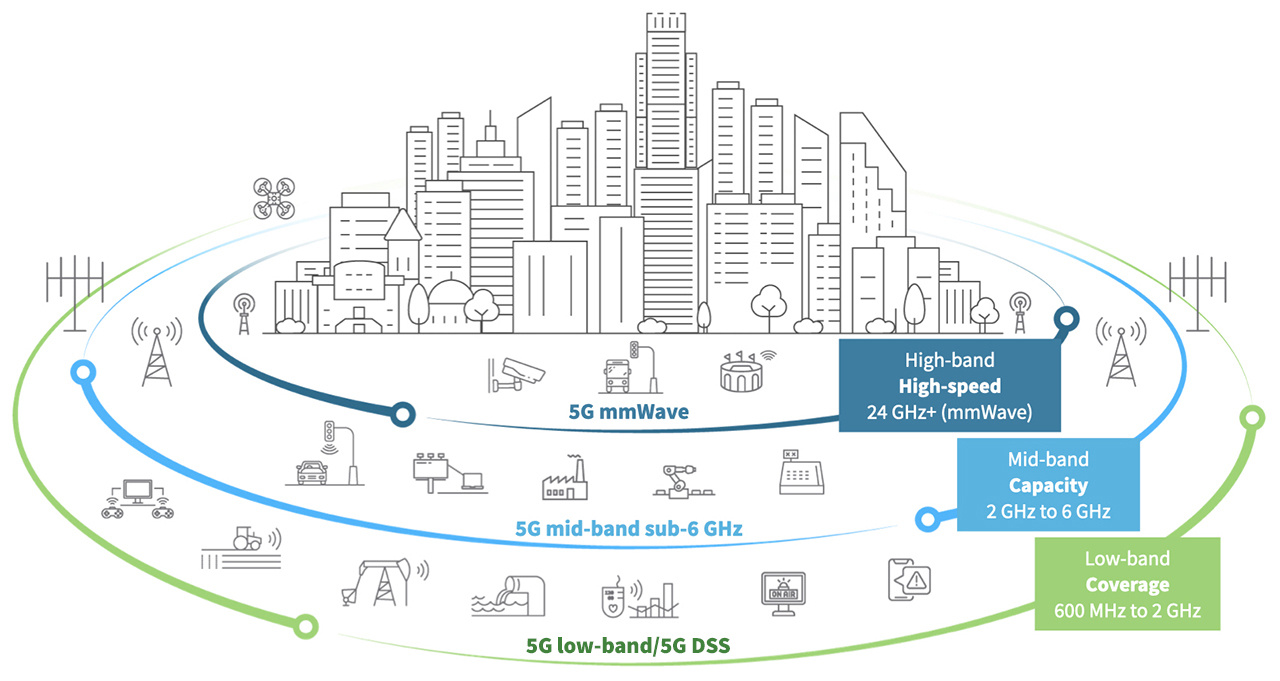
If you take one thing from this section: specify bands, not generations. A 4G LTE router typically lacks the mid-band frequencies your carrier uses in your deployment footprint, and it will significantly underperform a 5G router at the same site.
For more, see our blog on 5G network architecture and our post on C-band and why it matters for 5G.
Where 5G Delivers Today
The 2022 version of this post described autonomous vehicles and remote surgery. Those are still directionally right, but they are not where enterprises are getting value in 2026. The realized use cases are:
- Fixed wireless access (FWA): Now a primary WAN link, not just backup, for branch, retail and rural sites. FWA uptake is strongest in North America, the Nordics, the GCC and parts of Asia.
- Branch and enterprise WAN with failover: 5G primary with LTE or a second carrier as failover, managed centrally.
- Transportation and transit: Onboard video, passenger Wi-Fi and telematics consolidated onto fewer devices, with LTE fallback across the route.
- Utilities and critical infrastructure: SCADA, distribution automation and grid telemetry, increasingly on private LTE, CBRS or Anterix spectrum alongside public 5G.
- Video and edge inference: Camera-heavy sites where uplink, not downlink, is the binding constraint.
The Uplink Shift Nobody Planned For
This is the change most 4G-to-5G planning documents miss. Ericsson reports that uplink traffic is now growing faster than downlink for most service providers, with 43 of 55 measured providers seeing higher uplink growth, and models AI-driven traffic pushing uplink three times higher or more by 2031 compared to 2025.
For enterprise and IoT that reverses a long-standing design assumption. Edge video, cloud backup, user-generated content and AI workloads that push data up rather than pull it down are now the sizing driver. When you evaluate a router, check the uplink category, the number of transmit chains and whether the carrier support uplink carrier aggregation. A device with excellent downlink and a single weak uplink chain will bottleneck exactly the workloads that are growing fastest.
Is 5G Better Than LTE? A 2026 Reality Check
Yes, but conditionally. The honest summary:
| |
4G LTE |
Low-band 5G |
Mid-band 5G |
mmWave 5G |
| Typical real-world downlink |
Tens of Mbps |
Similar to LTE, modestly better |
Several times LTE |
Very high, very local |
| Typical latency |
30 to 50 ms |
20 to 40 ms |
10 to 30 ms |
Lowest |
| Coverage |
Near universal |
Very broad |
Broad and expanding |
Venue and hotspot only |
| Practical role |
Legacy and cost-sensitive IoT |
Coverage layer |
The capacity layer that matters |
Specialized |
Two additional points that only became clear after several years of deployment:
- 5G SA is where the latency and slicing benefits live. NSA 5G gives you throughput, not determinism.
- 5G already carries most of the load in leading markets. 5G carried 48 percent of global mobile data traffic at the end of 2025, projected to reach 85 percent by the end of 2031, and North America ended 2025 at 79 percent 5G subscription penetration.
What Is 5G Used for in IoT?
With its higher bandwidth, increased reliability and decrease in latency, 5G supports industry-changing advances in the IoT space, allowing devices to communicate with each other in the span of just a few milliseconds. Examples:
- Virtual reality: Virtual reality (VR) and augmented reality (AR) are not only for gamers but have uses in the medical field and in a multitude of training applications, where experts will be able to guide trainees remotely. High bandwidth and low-latency are key for this application.
- Autonomous cars: Self-driving cars will need to be able to communicate with each other, and with traffic management systems — and also detect the presence of pedestrians and obstacles — in fractions of a second. 5G's lower latency will reduce the time vehicles need to react to potential dangers, road construction, signage and other variables.
- Industrial automation: In precision automation applications, machines must be able to detect abnormalities in components, send alerts, stop conveyor belts, and other actions in real time. Having the capability to send these signals within milliseconds of a detected problem will significantly increase safety and efficiency in automation.
- Telemedicine and remote surgery: With its high speed and low latency, 5G will accelerate the development of telemedicine applications such as remote surgery. Using high-definition cameras and 5G connectivity, an operation performed by surgeons in one city can be livestreamed to a specialist in another city to advise the surgical team in real time as the operation takes place.

5G has moved well beyond early rollout — but coverage remains meaningfully uneven across regions and income levels. According to the ITU Facts and Figures 2025, 5G networks now cover approximately 55% of the world's population, up from just 17% in 2020 — a remarkable expansion in just five years.
Access, however, is far from uniform. The ITU reports that 84% of people in high-income countries have access to 5G, compared with only 4% in low-income countries. Leading markets include the Gulf Cooperation Council (GCC) states, Nordic countries, developed Asia Pacific, China, and the United States, where 5G Standalone deployment and network density are most advanced, according to the GSMA Intelligence State of 5G 2026 report.
Globally, 5G connections surpassed 2 billion by the end of 2024, with the GSMA Mobile Economy 2025 report projecting 5G will overtake 4G as the dominant mobile technology by 2028. For enterprise and IoT deployments, this means 5G is increasingly viable as a primary connectivity layer in major markets, while 4G LTE remains essential for coverage in rural regions and emerging economies where 5G build-out is still underway.
How Does 5G RedCap Fit in?
5G RedCap (Reduced Capability), also called NR-Light, was introduced in 3GPP Release 17 and is the single most important development for IoT since this post was first written. It fills the gap between LPWA technologies (LTE-M, NB-IoT) and full 5G eMBB, which is exactly where most industrial and commercial IoT sits.
How RedCap Reduces Cost and Power
RedCap trims device complexity in five specific ways:
- Maximum device bandwidth drops from 100 MHz to 20 MHz
- Minimum receive antennas drop to one or two, instead of four
- Fewer downlink MIMO layers
- Relaxed maximum downlink modulation order
- Optional half-duplex FDD operation
The result is roughly 50 to 200 Mbps downlink and up to about 50 Mbps uplink in a 20 MHz channel, comparable to LTE Cat 4 to Cat 7, with modem bill-of-material reduced on the order of 65 percent versus a baseline 5G eMBB device, along with a significant reduction in power required (important for solar and mobile applications).
Critically, RedCap keeps the 5G feature set: it runs on the 5G SA core, supports network slicing, and inherits the NR roadmap. That is the difference between buying a technology at the end of its life and one at the start of its life.
Where RedCap Stands in 2026
- The GSA reported in April 2026 that 42 operators across 27 countries are investing in RedCap, up sharply from 30 operators a year earlier.
- Commercial launches include T-Mobile and AT&T in the United States, all three major Chinese operators, Deutsche Telekom and Telefonica in Germany, SoftBank in Japan, M1 in Singapore, MasOrange in Spain, Etisalat in the UAE, Optus in Australia and others.
- AT&T launched nationwide 5G RedCap in 2025, positioning it explicitly for mid-tier IoT.
Should You Choose RedCap or LTE?
Use this as a first pass:
- Choose LTE Cat 1 / Cat 4 when the deployment is short-lived, extremely cost-sensitive, or in a market with no 5G SA coverage.
- Choose RedCap for new mid-tier deployments with a lifecycle beyond about five years: smart meters, distribution automation, telemetry, kiosks, ATMs, lottery terminals, digital signage, unattended retail and fixed remote monitoring.
- Choose full 5G eMBB for branch WAN, FWA, transit, video-heavy sites and anything needing carrier aggregation or high uplink.
Digi ships 5G RedCap today. The Digi IX25 industrial cellular router family covers LTE, 5G RedCap and 5G eMBB variants on a single hardware platform, which lets you standardize procurement, spares and management templates across sites with different requirements.
Carrier Spectrum Refarming from 4G to 5G
Spectrum is finite. Every Megahertz assigned to LTE is a megahertz not carrying 5G, and 5G NR is meaningfully more spectrally efficient in the same band. So carriers refarm: they move spectrum from an older air interface to a newer one, band by band and market by market.
This is the same mechanism that ended 2G and 3G. It is now pointed at LTE.
What Is Happening in the Spectrum Space?
- The three US carriers are all layering 5G onto bands that were LTE-only, including PCS, AWS and 700 MHz holdings, alongside their dedicated 5G mid-band (C-band for Verizon and AT&T, 2.5 GHz for T-Mobile).
- Dynamic Spectrum Sharing (DSS) allows one band to serve both LTE and NR simultaneously, which is how carriers smooth the transition rather than making a hard cut. DSS softens the transition but does not eliminate the capacity shift.
- T-Mobile has been widely reported (via internal documents surfaced in October 2025) to be planning a staged LTE refarm, with tighter approval requirements for new LTE-only and 5G NSA business activations from January 2026, the bulk of LTE spectrum reclaimed by around 2028, and a residual narrow LTE carrier maintained for legacy devices into the 2030s. This has not been confirmed as an official public timeline, and T-Mobile has publicly stated that an LTE shutdown remains years away. Treat it as a direction of travel, not a date, and validate with your carrier account team. See T-Mobile's own network evolution page for official notices.
- The US spectrum pipeline reopened in 2026. The FCC completed the AWS-3 re-auction (Auction 113) in June 2026, raising more than $3.5 billion across 200 mid-band licenses, its first major auction in four years, and is preparing an upper C-band auction of up to 160 MHz. New mid-band supply reduces the pressure to refarm LTE, but it does not remove it, because clearing and deployment take years. 5G Americas has a good overview of the mid-band supply picture.
What Refarming Means for Your Fleet
Refarming does not produce an outage notice. It produces a slow degradation that looks like everything else:
- Throughput drops at busy times and busy sites first
- Retries, session drops and longer reconnect times increase
- Coverage gaps appear at cell edge before they appear anywhere else
- New SIM or device activations get refused under updated carrier policy
The operational implication: instrument for it. If you cannot see per-device RAT, band, RSRP, SINR and session behavior across your fleet, you will discover a refarm through a support ticket rather than a dashboard. Digi Remote Manager provides that visibility along with the firmware and configuration management you need to respond without truck rolls.
Worth noting: RedCap and refarming are linked by design. Ericsson has been explicit that giving LTE-class IoT use cases a migration path to NR is precisely what accelerates LTE spectrum refarming. RedCap exists in part to let carriers empty the LTE layer faster.
Download our White Paper on 5G Frequency Bands
Learn about differences between 5G frequency bands, their benefits, and applications.
Download PDF
Future-Proofing Your 5G Deployment
"Future-proof" is an overused term, so here is a concrete definition: a deployment is future-proofed if it can survive a carrier spectrum refarm, a certification policy change and a carrier swap without a field visit.
That translates to seven requirements.
- Specify 5G SA capability, not just "5G." NSA-only devices depend on the LTE anchor that carriers are shrinking. SA capability is the requirement that separates a ten-year asset from a five-year one.
- Match bands to your actual footprint. Confirm the specific NR bands your carriers use at your sites, including C-band (n77/n78), 2.5 GHz (n41), low band, and CBRS (n48) or Anterix where relevant. Do this per region, not nationally.
- Size uplink deliberately. Given the uplink growth trend, treat uplink as a first-class requirement for any video, backup or edge AI workload.
- Use eSIM and dual SIM. eSIM lets you change carrier profiles remotely. In a refarm scenario, or a carrier certification change, that is the difference between a configuration push and a national truck roll.
- Treat modem firmware as an operational program. Carrier network configurations change. Modem firmware maintenance is not a one-time deployment task; budget for it over the asset life.
- Confirm carrier certification, in writing, for each operator and region you plan to deploy on, and confirm the vendor's lifecycle and support commitment for the SKU.
- Standardize on a platform, not a SKU. Site requirements vary. A platform that spans LTE, RedCap and eMBB variants on common hardware and common management lets you match the radio to the site without fragmenting your operations.
How Long Will 5G Itself Last?
Long enough. 5G is still gaining capability rather than losing it:
- 5G-Advanced began with 3GPP Release 18, continued through Release 19 (frozen in late 2025), and remains the focus of Release 20 through 2026 and 2027.
- 6G standardization has started, with the first implementable specifications expected around the end of 2028 or early 2029 and first commercial services around 2030. Normative 6G work lands in Release 21.
- 6G will start alongside 5G, not instead of it. The current forecast is 180 million 6G subscriptions by the end of 2031, against 6.4 billion for 5G. See our blog post on 6G.
Equipment specified for 5G SA today has a runway well into the 2030s. Equipment specified for LTE-only today does not.
Learn More About LTE vs. 5G
The short version of a long post:
- 5G is no longer the future case. It is the capacity layer, and mid-band is where the real difference lives.
- LTE will remain available for years, but the spectrum behind it is being reallocated, and LTE devices can fail on certification and capacity long before any shutdown.
- 5G RedCap closes the mid-tier IoT gap that made LTE the default for a decade, and it is commercially live on major carriers.
- Future-proofing means 5G SA, the right bands, eSIM, uplink headroom, and remote manageability.
Plan your deployment with Digi's enterprise (EX), industrial (IX) and transportation (TX) cellular routers, all integrated with Digi Remote Manager for monitoring, configuration and firmware management at scale.
Download our white paper on planning your journey to 5G, sign up for our newsletter, or contact us to start a conversation. Digi Professional Services can help plan and validate a migration across a distributed fleet.
4G LTE vs 5G FAQs
What's faster, 5G or LTE?
5G wins on raw speed. Today's 5G networks deliver around 1 Gbps in real-world conditions, with theoretical peaks up to 20 Gbps compared to 4G LTE's typical tens of Mbps range. But the size of that advantage depends heavily on which flavor of 5G is available where you're standing: low-band 5G is only about 20% faster than LTE, mid-band delivers speeds in the hundreds of Mbps, and high-band mmWave can hit up to 10x LTE speeds, though only at short range.
Speed isn't the whole story, either. 5G's bigger advantage for many applications is latency, dropping from LTE's typical 50–100 ms down to 10–20 ms in real-world 5G deployments (as low as 1 ms in ideal conditions). For things like industrial automation, autonomous vehicles, and remote surgery, that latency gap often matters more than top-line throughput.
Bottom line: 5G is faster, but "how much faster" ranges from barely noticeable to an order of magnitude, depending on spectrum band, tower proximity, and network build-out in your area.
How fast is 5G Internet speed?
5G Internet speed typically delivers 100–300+ Mbps in real-world use, with theoretical peaks up to 20 Gbps under ideal conditions. Ookla's H1 2026 US Connectivity Report measured a national median download speed of 314.38 Mbps on pure 5G connections, though actual speed varies significantly by carrier, location, and which 5G spectrum band you're connected to.
What is average 5G Internet speed by band?
Average 5G Internet speed depends heavily on spectrum band: low-band 5G runs 60–80 Mbps (barely ahead of LTE), mid-band 5G delivers 150–300 Mbps, and high-band mmWave 5G can reach 1–3 Gbps at short range. Most everyday 5G connections run on low- or mid-band spectrum, so real-world speeds tend to land well below the headline Gigabit numbers carriers advertise.
Which carrier has the fastest 5G Internet speed?
The fastest 5G Internet speed among major US carriers shifts from report to report, but Ookla's H1 2026 report named T-Mobile the winner for both Best Mobile Network and Fastest 5G Network. Rankings are worth rechecking regularly, since carriers continue investing heavily in spectrum and network buildout.
Does 5G replace LTE?
No. LTE and 5G often work together, with LTE providing coverage and fallback connectivity where 5G is unavailable.
Is LTE being shut down? When will LTE be retired?
No hard shutdown date has been set, and carriers have said an LTE shutdown remains years away. But LTE devices can start failing well before any official retirement. Carriers are gradually reallocating ("refarming") spectrum from LTE to 5G, which narrows LTE capacity over time rather than switching it off all at once.
In practice, this shows up as a "soft shutdown": throughput degrades first at busy sites and busy times, session drops and reconnects increase, and coverage gaps appear at cell edges before anywhere else. Carriers are also increasingly gating new SIM activations and device certifications on 5G capability, which means a technically functional LTE router can be refused a new activation even on a live network. The practical takeaway for anyone planning a deployment is this: Don't plan around a shutdown date. Plan around gradually degrading performance and tightening activation policy. Additionally, make sure your fleet is instrumented to catch it early rather than through a support ticket.
Should businesses upgrade from LTE to 5G?
Organizations should evaluate their connectivity requirements, performance goals, and coverage availability to make the right choice for their specific needs. It is important to note that with spectrum refarming, LTE viability will gradually decline. Organizations seeking to plan the right time to migrate to 5G should keep tabs on system performance, which will be a clearer signal that it's time to plan for migration than a specified shutdown date.
Is 4G or 5G better for IoT applications?
The best choice depends on the use case. LTE suits many current IoT deployments, while 5G enables more advanced, data-intensive applications.
What is the difference between 5G low-band, mid-band, and high-band (mmWave)?
Low-band 5G offers the widest coverage but speeds only modestly faster than LTE. Mid-band delivers the best balance of speed and coverage for urban and suburban deployments. High-band mmWave provides the fastest speeds but has limited range and struggles to penetrate walls, making it best suited for dense, short-range environments like stadiums, warehouses, and city blocks.
What is 5G Standalone (SA) and why does it matter?
5G Standalone uses a fully native 5G core network, unlocking the full benefits of 5G including ultra-low latency and network slicing. Most early 5G deployments used Non-Standalone (NSA) architecture, which relies on a 4G core and limits performance. SA deployments are now accelerating and represent the path to true next-generation 5G capability.
What is 5G RedCap and how is it different from LTE?
5G RedCap (Reduced Capability), also called NR-Light, is a lighter-weight 5G device category introduced in 3GPP Release 17 for mid-tier IoT — the space between low-power LPWA technologies like LTE-M and full 5G broadband. It trims device complexity (fewer antennas, narrower bandwidth, simpler modulation) to deliver speeds around 50–200 Mbps downlink, comparable to LTE Cat 4 to Cat 7, at roughly 65% lower modem cost and significantly lower power draw than a full 5G eMBB device.
The key difference from LTE isn't speed; it's the underlying network. RedCap runs on the 5G Standalone (SA) core, which means it inherits network slicing, the 5G feature roadmap, and a runway that extends well past LTE's. Choosing between them comes down to deployment lifespan: LTE Cat 1/Cat 4 still makes sense for short-lived or extremely cost-sensitive projects, but RedCap is the better long-term fit for anything with a lifecycle beyond about five years, since it's built on the network layer carriers are investing in rather than the one they're gradually reallocating spectrum away from.
What's the difference between 5G NSA and 5G SA?
Non-Standalone (NSA) 5G anchors its radio to an existing 4G LTE core network — it's how most early 5G was deployed, and it still depends on LTE infrastructure to function. Standalone (SA) 5G runs on a fully native 5G core with no LTE dependency at all.
That distinction matters more than the "5G" label itself. NSA gives you a throughput boost over LTE, but it doesn't unlock the features that make 5G a genuinely different network — SA is what enables network slicing, the lowest latency tiers, better device battery life, and 5G RedCap. A device that's "5G" but NSA-only is still tied to the LTE layer that carriers are actively shrinking through spectrum refarming, so for anything meant to stay in service for years, confirming SA capability — not just a 5G radio — is the more important spec to check.
What is a private LTE or private 5G network?
A private network is a dedicated LTE or 5G deployment built for a single organization rather than shared with the public. Private networks offer greater security, reliability, and control — making them popular in manufacturing, logistics, mining, and campus environments.
How does 5G improve industrial IoT and Industry 4.0 applications?
5G's ultra-low latency and high device density support real-time machine control, predictive maintenance, automated guided vehicles, and high-definition machine vision — applications that exceed what LTE can reliably deliver. Combined with edge computing, 5G enables data to be processed at or near the factory floor rather than routed to a distant data center.
What is the latency difference between 4G LTE and 5G?
4G LTE typically delivers latency of 50–100 milliseconds. 5G is engineered to reach latency as low as 1 millisecond under optimal conditions, with real-world deployments today commonly achieving 10–20 milliseconds. That gap is critical for applications like remote machine operation, autonomous vehicles, and real-time video collaboration.
Can 5G devices fall back to 4G LTE?
Yes. Most 5G devices support automatic fallback to 4G LTE when 5G coverage is unavailable. This makes 5G-capable routers and gateways a practical choice even in areas where 5G rollout is still in progress, protecting the hardware investment while ensuring continuous connectivity.
What is Fixed Wireless Access (FWA) and how does 5G enable it?
Fixed Wireless Access uses cellular connectivity — increasingly 5G — to deliver broadband internet to homes and businesses without a physical wired connection. 5G FWA is gaining traction as an alternative to fiber and cable, particularly in areas where trenching infrastructure is cost-prohibitive, and as a primary or backup connection for enterprise locations.
How does 5G affect network security?
5G introduces stronger encryption standards, improved authentication protocols, and network slicing — which allows organizations to isolate their traffic on a dedicated virtual network segment. These capabilities make 5G well-suited for security-sensitive applications in retail, finance, healthcare, and critical infrastructure.
Next Steps
Editorial note: This blog post was initially published in May of 2022, and was updated and republished in September 2026.